


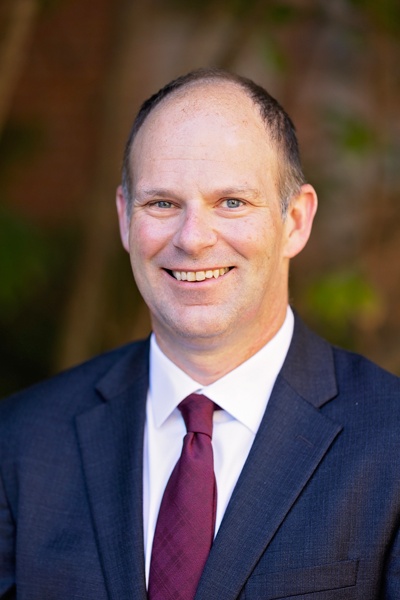
Kevin Keane is an assistant professor of public health and Master of Public Health (MPH) program director at Samford University's School of Public Health. Drawing on an interdisciplinary background that spans public health, psychology, counseling and business administration, Keane has worked across higher education, nonprofit and community settings. Prior to joining Samford University, he held leadership roles in academic program assessment, evaluation and nonprofit organizations.
Keane's work has focused on program evaluation, data-informed continuous quality improvement and the application of evidence-based public health approaches to build resilience and improve outcomes among individuals who have experienced trauma and adverse childhood experiences (ACEs). His professional experience includes leveraging data to strengthen programs, improve services and promote mental health, well-being and positive outcomes among individuals, families and vulnerable populations.
Keane's research examines adverse childhood experiences (ACEs), resilience, mental health and protective factors associated with positive educational, behavioral and health outcomes. He also maintains an active interest in program evaluation and applied research aimed at improving organizational effectiveness and informing evidence-based practice.
Through his teaching, service and leadership of the MPH program, Keane is committed to preparing future public health professionals to use data, evaluation and interdisciplinary collaboration to address complex public health challenges.
Degrees
- University of Alabama at Birmingham, Doctor of Philosophy, Health Education and Health Promotion
- University of Alabama at Birmingham, Master of Business Administration
- New Orleans Baptist Theological Seminary, Master of Arts in Marriage and Family Counseling
- Murray State University, Bachelor of Arts
- Certified Health Education Specialist
Involvement
- American Evaluation Association
- Society for Public Health Education
- Healthcare Information and Management Systems Society
Expertise
Evaluation, program planning, health behavior theory, adverse childhood experiences, protective factors and resilience.
Research Areas
-
Identifying protective factors and resilience frameworks to guide interventions that build resilience against the negative impact of adverse childhood experiences (ACEs) and childhood trauma
-
Examining the impact of trauma and adverse childhood experiences on educational and health outcomes, particularly for disadvantaged and underserved youth populations
- School-based public health interventions that promote teacher-student relationships to build resilience among students who have experienced trauma
- Innovative strategies in academic program and practice evaluation to guide quality improvement efforts and evaluate outcomes
Presentations
Paper/Podium Presentations
Sims, G.C., Parris, K., Bria, V., Ledlow, J., Bowen, F. and Keane, K. (2025, June). Improving student understanding of the impact of social determinants of health on health outcomes. AACN Access, Connection, Engagement (ACE) Symposium, Indianapolis, IN.
Heier, C., Jennings, M., Keane, K., Watts, P. and Moneyham, L. (2026, March). Faculty academy development program: Shaping nurse educators for today and tomorrow. 2026 Sigma Region 8 Conference, Tuscaloosa, AL.
Keane, K., Evans, R.R., Wilkinson, L.L., King, D.M., Leban, L. and Macrina, D. (2025, April). Leveraging the Gelberg-Andersen Model for Vulnerable Populations to improve outcomes among children who experienced ACEs. 2025 Society of Public Health Professionals Annual Conference, Long Beach, CA.
Keane, K., Evans, R., Wilkinson, L., King, D.M., Leban, L. and Macrina, D. (2024, March). Understanding how resilience frameworks build resilience against mental health issues among children who experienced ACEs. 2024 National Youth Advocacy and Resilience Conference, Savannah, GA.
Keane, K., Evans, R., Wilkinson, L., King, D.M., Leban, L. and Macrina, D. (2024, March). Identifying protective factors that promote better school-related outcomes among children who experienced ACEs. 2024 National Youth Advocacy and Resilience Conference, Savannah, GA.
Keane, K., Evans, R., Orihuela, C. and Mrug, S. (2023, March). The role of teacher relationships and stress in navigating early adolescence. 2023 Society for Public Health Education Annual Conference, Atlanta, GA.
Keane, K. and Evans, R. (2022, March). Resilience and mental health outcomes among children that experienced multiple adverse childhood experiences. National Youth Advocacy and Resilience Conference, Savannah, GA.
Keane, K. and Evans, R. (2022, March). The effect of teacher-student relationships and stress on psychosocial functioning during early adolescence. National Youth Advocacy and Resilience Conference, Savannah, GA.
Poster Presentations
Yerdon, A., Thurston, K., Richey, R., Keane, K., Brazeal, K., Lemoine, W., Waguespack, M., Woodfin, K. and Sherrer, M. (2026, February). Hypotension prediction index (HPI)-guided therapy: Benefits, limitations and the role of protocol compliance. American Association of Nurse Anesthesiology Edge Conference, Louisville, KY.
Keane, K. and Moneyham, L. (2025, April). Application of the 2024 CDC Program Evaluation Framework to guiding academic program evaluation. 2025 Society of Public Health Professionals Annual Conference, Long Beach, CA.
Keane, K. and Evans, R. (2021, July). Opportunities to leverage the WSCC model to build resilience to overcome adverse childhood experiences. American School Health Association’s 95th Annual Conference, virtual.
Keane, K., Royalty, J. and Ritter, A. (2003, May). Information versus education: Facts do not reduce stigmatization of depression. American Psychological Society’s 15th Annual Convention, Atlanta, GA.
Publications
Keane, K., Evans, R.R., Wilkinson, L.L., Moultrie King, D., Leban, L. and Macrina, D. (2025). Comparing the relationship between three resilience frameworks and mental health outcomes among children who experienced multiple adverse childhood experiences. Children and Youth Services Review, 172, 108237. https://doi.org/10.1016/j.childyouth.2025.108237
Sims, G.C., Claus, N., Etheridge, S., Keane, K., Campbell, C.M. and Moneyham, L. (2025). Evaluation of a joint enrollment pathway to the BSN degree. Teaching and Learning in Nursing, 20(3), e895-e900. https://doi.org/10.1016/j.teln.2025.03.016
Sims, G.C., Alspach, J., Ashley, K., Bumpus, J.G., Huddleston-Pettiway, L., Keane, K., Tofani, P., Parris, K. and Moneyham, L. (2025). Building a model for retention: Every student counts. Journal of Professional Nursing, 62, 36-44. https://doi.org/10.1016/j.profnurs.2025.10.009
Heier, C., Parris, K., Borella, K., Keane, K., Moneyham, L., Watts, P. and Suttle, R. (2025). Faculty academy model: Supporting nurse educators’ transition to academia. The Journal for Nurse Practitioners, 22(2), 105662. https://doi.org/10.1016/j.nurpra.2025.105662
Knight, C., Johnson, K., Keane, K., McKitt, T. and Fenn, H. (2024). Improving anxiety and depression in pregnant mothers participating in nurse home visitation. Journal of Psychosocial Nursing and Mental Health Services, 62(4), 49-55. https://doi.org/10.3928/02793695-20230919-06
Keane, K., Evans, R.R., Wilkinson, L.L., King, D.M., Leban, L. and Macrina, D. (2024). Adverse childhood experiences, protective factors and childhood obesity: Exploring the effectiveness of three resilience frameworks. Adversity and Resilience Science. https://doi.org/10.1007/s42844-024-00151-2
Keane, K., Evans, R.R., Orihuela, C.A. and Mrug, S. (2023). Teacher-student relationships, stress and psychosocial functioning during early adolescence. Psychology in the Schools, 60, 5124-5144. https://doi.org/10.1002/pits.23020
Keane, K. and Evans, R.R. (2022). Exploring the relationship between modifiable protective factors and mental health issues among children experiencing adverse childhood experiences using a resilience framework. Journal of Child & Adolescent Trauma, 15(4), 987-998. https://doi.org/10.1007/s40653-022-00471-4
Keane, K. and Evans, R. (2022). The potential for teacher-student relationships and the whole school, whole community, whole child model to mitigate adverse childhood experiences. Journal of School Health, 92(5), 504-513. https://doi.org/10.1111/josh.13154
