


The 2026 World Cup is the largest in the tournament’s history: 48 teams, 12 groups of four, and a brand-new Round of 32. With it comes a familiar promise — and a familiar worry. A bigger field should mean more chaos, more dark horses, and a harder road for the favorites.
That intuition is testable. The same Elo-and-Poisson modeling engine used to forecast soccer matches can be pointed at a cleaner question: hold the teams fixed, change only the rulebook, and measure what the expansion actually does.
One engine, two rulebooks, 30,000 tournaments
The experiment is deliberately controlled. A Monte Carlo simulation played out 30,000 World Cups under the old 32-team format and another 30,000 under the new 48-team format, using identical team strengths drawn from Elo ratings as of mid-June 2026.
In each simulated match, expected goals scale with the Elo gap between the two sides, goals are drawn from a Poisson distribution, and knockout ties go to a near-coin-flip shootout. The only thing that differs between the two sets of tournaments is the structure: eight groups feeding a Round of 16, versus twelve groups feeding a Round of 32.
The favorites lose a little air
The headline effect is real but modest. Under the 32-team format, the four strongest teams — Spain, Argentina, France and England — won 67.3% of simulated titles between them. Under the 48-team format, that share slips to 64.4%.
Widen the lens to the top eight and the pattern holds: a combined 86.4% under the old format, 83.2% under the new one. No single giant collapses — Spain, the model’s favorite, eases from roughly 24.8% to 23.4% — but almost every big name surrenders a sliver of probability. And that probability has to go somewhere.
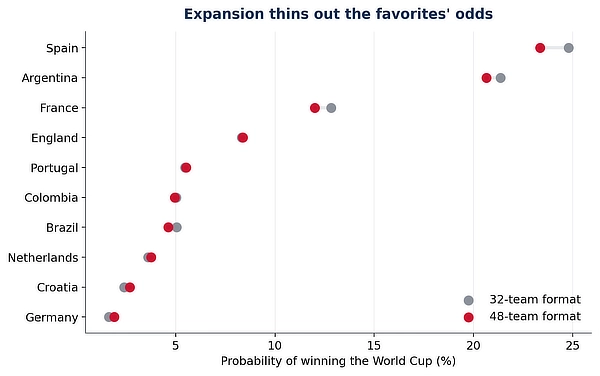
Figure 1. Title odds for the top 10 teams under each format. The strongest sides shift left; several second-tier teams edge right.
The trophy drifts toward the chasing pack
Where it goes is the more interesting part. The teams that gain are not the minnows; they are the second tier — the Croatias, Germanys and Netherlands of the field, who collect the probability the giants give up.
The chance that the eventual champion comes from outside the pre-tournament top 16 rises from about 2.8% to 4.3%. In relative terms a true outsider is roughly 50% more likely to win under the bigger format — though the absolute figure stays small.
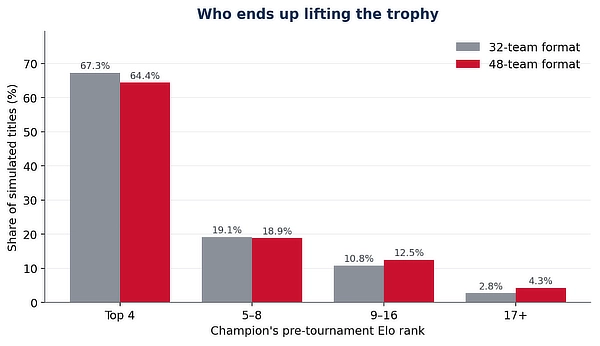
Figure 2. The champion’s pre-tournament Elo rank. Probability mass shifts away from the very top and toward the chasing pack.
More upsets, but not more coin flips
A bigger bracket produces more shocks in raw count: the simulated 48-team tournament sees about 9.6 knockout upsets, versus 5.0 in the 32-team version. That is mostly arithmetic — the new format has more than twice as many knockout games (31 versus 15).
The upset rate per knockout match barely moves, and even edges down a touch (31.0% versus 33.4%), because the extra Round of 32 mostly pits strong group winners against weaker qualifiers. Expansion does not make any single game more of a toss-up. It simply adds more games.
Why expansion nudges rather than upends
The mechanism is straightforward. A 48-team champion must win eight matches instead of seven, and each extra knockout round is one more chance — however small — to be ambushed.
The added teams are weak and rarely win, so they claim little title probability themselves. But the extra elimination round they create forces every favorite to survive one more roll of the dice. Compounded over a deep run, those small risks shave a few points off the top of the field.
What to watch for in 2026
The data argues for a measured expectation. The 48-team World Cup is not a great equalizer that will routinely crown unlikely champions; the favorites remain the favorites.
But it does widen the door slightly. A second-tier contender’s path is a little more open, the field’s odds are a little less top-heavy, and the tournament carries slightly more variance than its predecessor. For neutrals hoping for a surprise, a little is still more than none.
The numbers behind the story
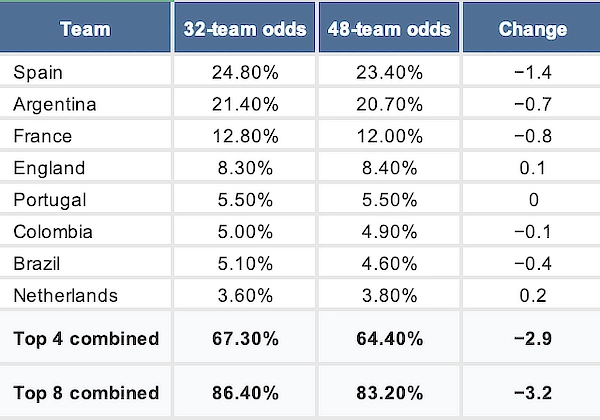
Table 1. Simulated title probabilities under each format (selected teams). Full inputs and outputs are in the accompanying spreadsheet.
A note on method. Figures come from 30,000-iteration Monte Carlo simulations under each format, using an Elo-plus-Poisson match model. Team strengths are approximate Elo ratings as of mid-June 2026; because the study compares formats over identical strengths, the redistribution finding is robust to the exact rating of any single team. Charts and the full data set accompany this article as a spreadsheet.
References
- eloratings.net. (2026). World Football Elo Ratings. Retrieved June 2026, from https://www.eloratings.net
- Fédération Internationale de Football Association. (2023). How the FIFA World Cup 26 will work with 48 teams. FIFA. https://www.fifa.com
- Joury, A., Gao, H., Hu, G., & Shen, W. (2026). Soccer Analytics with Machine Learning. O’Reilly Media.


